what continent does the middle east belong to
Coordinates: 29°N 41°Due east / 29°North 41°Eastward / 29; 41
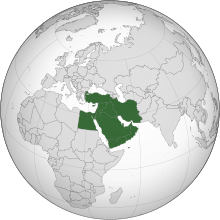 | |
| Area | 7,207,575 km2 (two,782,860 sq mi) |
|---|---|
| Population | 371 one thousand thousand (2010)[i] |
| Countries | United nations member states (sixteen)
UN observer state (ane)
Disputed (1)
|
| Dependencies | External (one)
Internal (3)
Disputed (two)
Un Buffer Zones (2)
|
| Languages | 60 languages
|
| Fourth dimension zones | UTC+02:00, UTC+03:00, UTC+03:30, UTC+04:00, UTC+04:xxx |
| Largest cities | Largest cities:
|


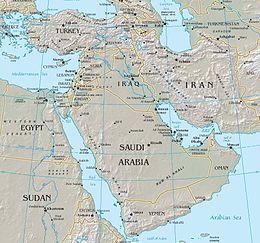
Map of the Middle East between Africa, Europe, Cardinal Asia, and Southern asia.

Centre East map of Köppen climate nomenclature.
The Middle East (Arabic: الشرق الأوسط, ISO 233: ash-Sharq al-Awsat ) is a geopolitical term[2] that commonly refers to the region spanning the Levant, Arabian Peninsula, Anatolia (including modern Turkey and Cyprus), Egypt, Iran and Republic of iraq. The term came into widespread usage as a replacement of the term Near East (as opposed to the Far East) beginning in the early 20th century. The term "Middle East" has led to some confusion over its changing definitions, and has been viewed by some to be discriminatory[3] or likewise Eurocentric.[four] The region includes the vast majority of the territories included in the closely associated definition of Western asia, only without the Caucasus and including all of Egypt, and not just the Sinai Peninsula.
Most Center Eastern countries (13 out of 18) are part of the Arab earth. The about populous countries in the region are Arab republic of egypt, Iran, and Turkey, while Saudi Arabia is the largest Middle Eastern country by surface area. The history of the Middle East dates dorsum to ancient times, with the geopolitical importance of the region being recognized for millennia.[5] [half dozen] [seven] Several major religions have their origins in the Center East, including Judaism, Christianity, and Islam.[8] Arabs plant the primary socioethnic grouping in the region,[9] followed by Turks, Persians, Kurds, Azeris, Copts, Jews, Assyrians, Iraqi Turkmen, and Greek Cypriots.
The Centre East generally has a hot, arid climate, specially in the Peninsula and Egyptian regions. Several major rivers providing irrigation to back up agriculture in limited areas here such as the Nile Delta in Egypt, the Tigris and Euphrates watersheds of Mesopotamia (Iraq, Kuwait, and eastern Syrian arab republic), and most of what is known as the Fertile Crescent. Conversely the Levantine coast and most of Turkey have more temperate, oceanic and wetter climates. Almost of the countries that border the Persian Gulf accept vast reserves of petroleum, with monarchs of the Arabian Peninsula in particular benefiting economically from petroleum exports. Considering of the arid climate and heavy reliance on the fossil fuel industry, the Middle E is both a heavy contributor to climate change and a region expected to be severely negatively impacted by it.
Other concepts of the region exist including the broader the Middle East and North Africa (MENA), which includes states of the Maghreb and Sudan, or the "Greater Heart East" which additionally also includes parts of Due east Africa, Afghanistan, Islamic republic of pakistan, and sometimes the South Caucasus and Fundamental Asia.
Terminology
The term "Middle East" may have originated in the 1850s in the British Republic of india Office.[10] However, information technology became more widely known when American naval strategist Alfred Thayer Mahan used the term in 1902[eleven] to "designate the surface area between Arabia and Bharat".[12] [thirteen] During this time the British and Russian Empires were vying for influence in Key Asia, a rivalry which would become known as the Great Game. Mahan realized not merely the strategic importance of the region, just besides of its center, the Persian Gulf.[14] [fifteen] He labeled the area surrounding the Farsi Gulf equally the Middle E, and said that later Egypt'due south Suez Canal, it was the about of import passage for Britain to control in lodge to keep the Russians from advancing towards British India.[16] Mahan kickoff used the term in his article "The Persian Gulf and International Relations", published in September 1902 in the National Review, a British journal.
The Eye East, if I may adopt a term which I have non seen, will some mean solar day need its Malta, likewise as its Gibraltar; it does not follow that either will be in the Persian Gulf. Naval forcefulness has the quality of mobility which carries with it the privilege of temporary absences; but information technology needs to discover on every scene of operation established bases of refit, of supply, and in case of disaster, of security. The British Navy should take the facility to concentrate in forcefulness if occasion arise, about Aden, Bharat, and the Western farsi Gulf.[17]
Mahan'south article was reprinted in The Times and followed in October by a 20-article series entitled "The Middle Eastern Question," written by Sir Ignatius Valentine Chirol. During this series, Sir Ignatius expanded the definition of Middle East to include "those regions of Asia which extend to the borders of India or command the approaches to Republic of india."[18] Afterward the serial concluded in 1903, The Times removed quotation marks from subsequent uses of the term.[19]
Until World State of war 2, it was customary to refer to areas centered effectually Turkey and the eastern shore of the Mediterranean as the "Near East", while the "Far Due east" centered on Prc,[20] and the Middle E then meant the area from Mesopotamia to Burma, namely the area between the Near East and the Far East.[ citation needed ] In the late 1930s, the British established the Center E Command, which was based in Cairo, for its military machine forces in the region. Later that time, the term "Middle East" gained broader usage in Europe and the United States, with the Centre Due east Found founded in Washington, D.C. in 1946, among other usage.[21]
The corresponding describing word is Middle Eastern and the derived noun is Middle Easterner.
While not-Eurocentric terms such "Southwest Asia" or "Swasia" has been sparsedly used, the inclusion of an African country, Egypt, in the definition questions the usefulness of using such terms.[22]
Usage and criticism
1957 American film virtually the Middle Due east
The description Middle has also led to some defoliation over changing definitions. Before the First World War, "Near E" was used in English to refer to the Balkans and the Ottoman Empire, while "Center Due east" referred to the Caucasus, Persia, and Arabian lands,[23] and sometimes Afghanistan, India and others.[24] In contrast, "Far Eastward" referred to the countries of Eastern asia (east.one thousand. China, Japan and Korea).[25] [26]
With the plummet of the Ottoman Empire in 1918, "Near East" largely fell out of common utilize in English, while "Middle Due east" came to be applied to the re-emerging countries of the Islamic globe. However, the usage "Near Eastward" was retained by a diverseness of academic disciplines, including archaeology and aboriginal history, where it describes an area identical to the term Centre E, which is not used by these disciplines (run across Aboriginal Near East).[ commendation needed ]
The first official utilize of the term "Middle East" by the United States regime was in the 1957 Eisenhower Doctrine, which pertained to the Suez Crisis. Secretary of State John Foster Dulles defined the Heart East as "the surface area lying between and including Libya on the west and Pakistan on the eastward, Syrian arab republic and Iraq on the N and the Arabian peninsula to the southward, plus the Sudan and Ethiopia."[20] In 1958, the State Department explained that the terms "Well-nigh E" and "Middle East" were interchangeable, and defined the region every bit including only Egypt, Syrian arab republic, State of israel, Lebanon, Jordan, Iraq, Kingdom of saudi arabia, State of kuwait, Bahrain, and Qatar.[27]
The term Middle E has also been criticised past journalist Louay Khraish and historian Hassan Hanafi for being a Eurocentric and colonialist term.[3] [iv] [28]
The Associated Printing Stylebook says that Almost East formerly referred to the further west countries while Middle Eastward referred to the eastern ones, but that at present they are synonymous. It instructs:
Use Middle East unless Near Due east is used by a source in a story. Mideast is besides adequate, but Middle East is preferred.[29]
Translations
There are terms like to Near East and Middle Eastward in other European languages, but since information technology is a relative description, the meanings depend on the country and are unlike from the English language terms generally. In German the term Naher Osten (Virtually East) is all the same in common employ (nowadays the term Mittlerer Osten is more and more mutual in press texts translated from English sources, albeit having a distinct pregnant) and in Russian Ближний Восток or Blizhniy Vostok, Bulgarian Близкия Изток, Smooth Bliski Wschód or Croatian Bliski istok (significant Near Eastward in all the 4 Slavic languages) remains as the only appropriate term for the region. However, some languages do have "Eye Eastward" equivalents, such as the French Moyen-Orient, Swedish Mellanöstern, Spanish Oriente Medio or Medio Oriente, and the Italian Medio Oriente.[note i]
Perchance because of the influence of the Western printing, the Arabic equivalent of Centre Due east (Arabic: الشرق الأوسط ash-Sharq al-Awsaṭ) has become standard usage in the mainstream Arabic press, comprising the same meaning as the term "Centre E" in Northward American and Western European usage. The designation, Mashriq, too from the Standard arabic root for East, also denotes a variously defined region around the Levant, the eastern part of the Arabic-speaking earth (every bit opposed to the Maghreb, the western office).[30] Even though the term originated in the West, apart from Standard arabic, other languages of countries of the Middle East also use a translation of it. The Persian equivalent for Heart East is خاورمیانه (Khāvar-eastward miyāneh), the Hebrew is המזרח התיכון (hamizrach hatikhon), the Turkish is Orta Doğu and the Greek is Μέση Ανατολή (Mesi Anatoli).
Territories and regions
Territories and regions usually considered inside the Middle E
Traditionally included within the Center East are Islamic republic of iran (Persia), Asia Minor, Mesopotamia, the Levant, the Arabian Peninsula, and Egypt. In modern-day-state terms they are these:
| Arms | Flag | State | Area (km2) | Population (2021) | Density (per km2) | Upper-case letter | Nominal GDP, bn (2020)[31] | Per capita (2020)[32] | Currency | Regime | Official languages |
|---|---|---|---|---|---|---|---|---|---|---|---|
 |  | Akrotiri and Dhekelia | 254 | 18,195 | 72 | Episkopi | Due north/A | Northward/A | Euro | De facto stratocratic dependency under a constitutional monarchy | English |
 |  | Bahrain | 780 | 1,501,635 | ane,925 | Manama | $33.904 | $22,402 | Bahraini dinar | Accented monarchy | Arabic |
 |  | Cyprus | nine,250 | 888,005 | 96 | Nicosia | $23.967 | $27,053.viii | Euro | Presidential commonwealth | Greek, Turkish |
 |  | Egypt | 1,010,407 | 102,678,136 | 102 | Cairo | $361.847 | $3,586.97 | Egyptian pound | Presidential democracy | Arabic |
 |  | Islamic republic of iran | 1,648,195 | 85,022,548 | 52 | Tehran | $635.724 | $7,554.77 | Iranian rial | Islamic republic | Persian |
 |  | Iraq | 438,317 | 41,190,700 | 82.vii | Baghdad | $172.119 | $4,288.77 | Iraqi dinar | Parliamentary democracy | Arabic, Kurdish |
 |  | State of israel | 20,770 | 9,443,420 | 455 | Jerusalema | $402.639 | $43,688.58 | Israeli shekel | Parliamentary republic | Hebrew |
 |  | Hashemite kingdom of jordan | 92,300 | 11,098,276 | 120 | Amman | $43.481 | $4,259.26 | Jordanian dinar | Constitutional monarchy | Arabic |
 |  | Kuwait | 17,820 | 4,670,713 | 262 | Kuwait City | $107.936 | $22,105.09 | Kuwaiti dinar | Constitutional monarchy | Standard arabic |
 |  | Lebanon | 10,452 | 6,769,000 | 648 | Beirut | $19.126 | $2,802.14 | Lebanese pound | Parliamentary republic | Standard arabic |
 |  | Oman | 212,460 | 4,447,408 | 21 | Muscat | $63.192 | $xiv,215.58 | Omani rial | Accented monarchy | Arabic |
 |  | Palestine | 6,220 | 5,227,193 | 840 | Ramallaha | $fifteen.519 | $3,042.17 | Israeli shekel, Jordanian dinar | Semi-presidential republic | Standard arabic |
 |  | Qatar | 11,437 | two,799,202 | 245 | Doha | $146.09 | $52,144.sixteen | Qatari riyal | Absolute monarchy | Standard arabic |
 |  | Saudi arabia | 2,149,690 | 35,013,414 | xvi | Riyadh | $701.467 | $20,178.23 | Saudi riyal | Absolute monarchy | Arabic |
 |  | Syria | 185,180 | eighteen,276,000 | 99 | Damascus | $threescore.043 | $3,285.35 | Syrian pound | Presidential republic | Arabic |
 | Turkey | 783,562 | 83,614,362 | 107 | Ankara | $719.537 | $eight,548.18 | Turkish lira | Presidential commonwealth | Turkish | |
 |  | United Arab Emirates | 82,880 | nine,503,738 | 115 | Abu Dhabi | $354.279 | $31,982.23 | Emirati dirham | Federal constitutional monarchy | Arabic |
 |  | Yemen | 527,970 | 30,491,000 | 58 | Sana'ab Aden (provisional) | $20.fourteen | $620.24 | Yemeni rial | Conditional presidential commonwealth | Arabic |
- a. ^ ^ Jerusalem is the proclaimed capital of Israel, which is disputed and the actual location of the Knesset, Israeli Supreme Court, and other governmental institutions of Israel. Ramallah is the actual location of the regime of Palestine, whereas the proclaimed capital of Palestine is East Jerusalem, which is disputed.
- b. ^ Controlled past the Houthis due to the ongoing war. Seat of government moved to Aden.
Other definitions of the Middle East
Various concepts are oftentimes being paralleled to Eye E, nearly notably Nigh East, Fertile Crescent and the Levant. Most E, Levant and Fertile Crescent are geographic concepts, which refer to large sections of the modern defined Middle E, with Virtually East beingness the closest to Middle Due east in its geographic meaning. Due to it primarily being Standard arabic speaking, the Maghreb region of N Africa is sometimes included.
The countries of the South Caucasus—Armenia, Azerbaijan, and Georgia—are occasionally included in definitions of the Eye East.[33]
The Greater Middle East was a political term coined by the second Bush administration in the get-go decade of the 21st century,[34] to denote various countries, pertaining to the Muslim world, specifically Iran, Turkey, Afghanistan and Pakistan.[35] Diverse Central Asian countries are sometimes also included.[36]
History

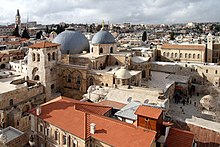

The Middle Due east lies at the juncture of Eurasia and Africa and of the Mediterranean Sea and the Indian Ocean. It is the birthplace and spiritual eye of religions such as Christianity, Islam, Judaism, Manichaeism, Yezidi, Druze, Yarsan and Mandeanism, and in Iran, Mithraism, Zoroastrianism, Manicheanism, and the Baháʼí Organized religion. Throughout its history the Center Due east has been a major center of world diplomacy; a strategically, economically, politically, culturally, and religiously sensitive area. The region is one of the regions were agronomics was independently discovered, and from the Eye East information technology was spread, during the Neolithic, to dissimilar regions of the world such as Europe, the Indus Valley and Eastern Africa.
Prior to the formation of civilizations, advanced cultures formed all over the Middle East during the Stone Age. The search for agricultural lands by agriculturalists, and pastoral lands past herdsmen meant different migrations took identify inside the region and shaped its ethnic and demographic makeup.
The Middle East is widely and most famously known equally the Cradle of civilization. The globe'southward earliest civilizations, Mesopotamia (Sumer, Akkad, Assyria and Babylonia), ancient Egypt and Kish in the Levant, all originated in the Fertile Crescent and Nile Valley regions of the ancient Most Due east. These were followed past the Hittite, Greek, Hurrian and Urartian civilisations of Asia Minor; Elam, Persia and Median civilizations in Iran, equally well as the civilizations of the Levant (such as Ebla, Mari, Nagar, Ugarit, Canaan, Aramea, Mitanni, Phoenicia and State of israel) and the Arabian Peninsula (Magan, Sheba, Ubar). The Near E was first largely unified under the Neo Assyrian Empire, then the Achaemenid Empire followed afterward by the Macedonian Empire and after this to some caste by the Iranian empires (namely the Parthian and Sassanid Empires), the Roman Empire and Byzantine Empire. The region served as the intellectual and economic heart of the Roman Empire and played an exceptionally important role due to its periphery on the Sassanid Empire. Thus, the Romans stationed upwards to five or 6 of their legions in the region for the sole purpose of defending it from Sassanid and Bedouin raids and invasions.
From the 4th century CE onwards, the Heart Eastward became the center of the two main powers at the time, the Byzantine empire and the Sassanid Empire. Withal, it would be the afterward Islamic Caliphates of the Middle Ages, or Islamic Gilt Age which began with the Islamic conquest of the region in the 7th century Advertising, that would first unify the entire Heart Due east as a distinct region and create the dominant Islamic Arab indigenous identity that largely (only not exclusively) persists today. The 4 caliphates that dominated the Center East for more than than 600 years were the Rashidun Caliphate, the Umayyad caliphate, the Abbasid caliphate and the Fatimid caliphate. Additionally, the Mongols would come to dominate the region, the Kingdom of Armenia would incorporate parts of the region to their domain, the Seljuks would rule the region and spread Turko-Persian culture, and the Franks would establish the Crusader states that would stand for roughly 2 centuries. Josiah Russell estimates the population of what he calls "Islamic territory" every bit roughly 12.5 million in m – Anatolia 8 million, Syria ii million, and Egypt 1.5 million.[37] From the 16th century onward, the Centre East came to be dominated, once more, by two main powers: the Ottoman Empire and the Safavid dynasty.
The mod Middle Due east began after World State of war I, when the Ottoman Empire, which was allied with the Central Powers, was defeated by the British Empire and their allies and partitioned into a number of carve up nations, initially nether British and French Mandates. Other defining events in this transformation included the establishment of Israel in 1948 and the eventual departure of European powers, notably United kingdom and France by the end of the 1960s. They were supplanted in some part by the ascent influence of the United states of america from the 1970s onwards.
In the 20th century, the region's meaning stocks of crude oil gave information technology new strategic and economical importance. Mass production of oil began around 1945, with Saudi Arabia, Iran, Kuwait, Iraq, and the United Arab Emirates having large quantities of oil.[38] Estimated oil reserves, especially in Saudi Arabia and Iran, are some of the highest in the world, and the international oil cartel OPEC is dominated by Center Eastern countries.
During the Common cold War, the Center East was a theater of ideological struggle between the two superpowers and their allies: NATO and the United States on one side, and the Soviet Wedlock and Warsaw Pact on the other, as they competed to influence regional allies. Likewise the political reasons there was also the "ideological conflict" between the two systems. Moreover, as Louise Fawcett argues, amid many important areas of contention, or peradventure more accurately of anxiety, were, showtime, the desires of the superpowers to proceeds strategic advantage in the region, second, the fact that the region contained some two-thirds of the world's oil reserves in a context where oil was becoming increasingly vital to the economy of the Western world [...][39] Within this contextual framework, the U.s.a. sought to divert the Arab world from Soviet influence. Throughout the 20th and 21st centuries, the region has experienced both periods of relative peace and tolerance and periods of conflict particularly between Sunnis and Shiites.
Demographics
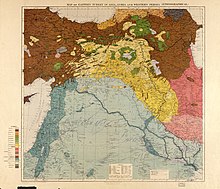
Maunsell's map, a Pre-Globe State of war I British Ethnographical Map of the Middle East
Ethnic groups
Arabs constitute the largest ethnic group in the Middle East, followed by various Iranian peoples and then by Turkic speaking groups (Turkish, Azeris, and Iraqi Turkmen). Native indigenous groups of the region include, in addition to Arabs, Arameans, Assyrians, Baloch, Berbers, Copts, Druze, Greek Cypriots, Jews, Kurds, Lurs, Mandaeans, Persians, Samaritans, Shabaks, Tats, and Zazas. European indigenous groups that form a diaspora in the region include Albanians, Bosniaks, Circassians (including Kabardians), Crimean Tatars, Greeks, Franco-Levantines, Italo-Levantines, and Iraqi Turkmens. Among other migrant populations are Chinese, Filipinos, Indians, Indonesians, Pakistanis, Pashtuns, Romani, and Afro-Arabs.
Migration
"Migration has ever provided an important vent for labor market place pressures in the Middle Due east. For the period between the 1970s and 1990s, the Arab states of the Persian Gulf in particular provided a rich source of employment for workers from Egypt, Yemen and the countries of the Levant, while Europe had attracted young workers from N African countries due both to proximity and the legacy of colonial ties between France and the bulk of North African states."[40] According to the International Organization for Migration, there are 13 million first-generation migrants from Arab nations in the world, of which 5.8 reside in other Arab countries. Expatriates from Arab countries contribute to the circulation of financial and human capital in the region and thus significantly promote regional development. In 2009 Arab countries received a total of US$35.1 billion in remittance in-flows and remittances sent to Jordan, Egypt and Lebanon from other Arab countries are 40 to 190 per cent higher than trade revenues between these and other Arab countries.[41] In Somalia, the Somali Ceremonious War has greatly increased the size of the Somali diaspora, as many of the best educated Somalis left for Middle Eastern countries too equally Europe and North America.
Non-Arab Centre Eastern countries such equally Turkey, State of israel and Iran are as well field of study to important migration dynamics.
A off-white proportion of those migrating from Arab nations are from indigenous and religious minorities facing racial and or religious persecution and are not necessarily ethnic Arabs, Iranians or Turks.[ commendation needed ] Large numbers of Kurds, Jews, Assyrians, Greeks and Armenians likewise as many Mandeans have left nations such as Republic of iraq, Islamic republic of iran, Syria and Turkey for these reasons during the last century. In Islamic republic of iran, many religious minorities such equally Christians, Baháʼís, Jews and Zoroastrians accept left since the Islamic Revolution of 1979.[42] [43]
Religions
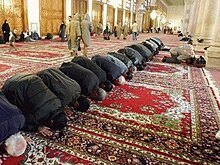
Islam is the largest religion in the Eye Eastward. Here, Muslim men are prostrating during prayer in a mosque.
The Eye East is very diverse when it comes to religions, many of which originated at that place. Islam is the largest religion in the Middle East, merely other faiths that originated there, such equally Judaism and Christianity,[44] are also well represented. Christian communities have played a vital role in the Middle East,[45] and they stand for forty.5% of Lebanon, where the Lebanese president, half of the chiffonier, and half of the parliament follow one of the various Lebanese Christian rites. There are also important minority religions like the Baháʼí Organized religion, Yarsanism, Yazidism,[46] Zoroastrianism, Mandaeism, Druze,[47] and Shabakism, and in ancient times the region was habitation to Mesopotamian religions, Canaanite religions, Manichaeism, Mithraism and various monotheist gnostic sects.
Languages
The six superlative languages, in terms of numbers of speakers, are Arabic, Persian, Turkish, Kurdish, Hebrew and Greek. Standard arabic and Hebrew represent the Afro-Asiatic linguistic communication family unit. Persian, Kurdish and Greek vest to the Indo-European language family. Turkish belongs to Turkic language family. Nigh 20 minority languages are also spoken in the Middle East.
Arabic, with all its dialects, is the most widely spoken language in the Middle East, with Literary Arabic beingness official in all North African and in almost W Asian countries. Arabic dialects are likewise spoken in some adjacent areas in neighbouring Centre Eastern non-Arab countries. It is a member of the Semitic branch of the Afro-Asiatic languages. Several Modernistic South Arabian languages such every bit Mehri and Soqotri are also spoken Yemen and Oman. Some other Semitic language such as Aramaic and its dialects are spoken mainly by Assyrians and Mandaeans. There is also an Oasis Berber-speaking community in Egypt where the language is too known equally Siwa. It is a not-Semitic Afro-Asiatic language.
Farsi is the 2d almost spoken linguistic communication. While it is primarily spoken in Islamic republic of iran and some border areas in neighbouring countries, the country is ane of the region's largest and near populous. It belongs to the Indo-Iranian co-operative of the family of Indo-European languages. Other Western Iranic languages spoken in the region include Achomi, Daylami, Kurdish dialects, Semmani, Lurish, amongst many others.
The third-well-nigh widely spoken language, Turkish, is largely bars to Turkey, which is also one of the region'south largest and most populous countries, only it is present in areas in neighboring countries. It is a fellow member of the Turkic languages, which take their origins in Central Asia. Another Turkic language, Azeri, is spoken by Azerbaijanis in Iran.
Hebrew is one of the ii official languages of Israel, the other being Arabic. Hebrew is spoken and used past over lxxx% of Israel's population, the other 20% using Standard arabic.
Greek is i of the two official languages of Cyprus, and the country'south main language. Modest communities of Greek speakers exist all effectually the Middle East; until the 20th century information technology was also widely spoken in Asia Minor (being the 2d most spoken language there, after Turkish) and Egypt. During the antiquity, Ancient Greek was the lingua franca for many areas of the western Middle Eastward and until the Muslim expansion it was widely spoken at that place as well. Until the tardily 11th century, it was likewise the master spoken language in Asia Modest; after that it was gradually replaced by the Turkish linguistic communication as the Anatolian Turks expanded and the local Greeks were assimilated, specially in the interior.
English language is 1 of the official languages of Akrotiri and Dhekelia.[48] [49] Information technology is also commonly taught and used as a 2nd language, peculiarly among the middle and upper classes, in countries such as Arab republic of egypt, Jordan, Iran, Kurdistan, Iraq, Qatar, Bahrain, United Arab Emirates and Kuwait.[50] [51] It is also a main language in some Emirates of the United Arab Emirates. It is also spoken equally native language by Jewish immigrants from Anglophone countries (Great britain, USA, Australia) in Israel and understood widely as second linguistic communication there.
French is taught and used in many regime facilities and media in Lebanon, and is taught in some primary and secondary schools of Egypt and Syria. Maltese, a Semitic language mainly spoken in Europe, is as well used past the Franco-Maltese diaspora in Egypt. Too, due to widespread immigration of French Jews to State of israel, it is the native linguistic communication of approximately 200,000 Jews of Israel.
Armenian speakers are too to be found in the region. Georgian is spoken past the Georgian diaspora.
Russian is spoken past a big portion of the Israeli population, because of emigration in the belatedly 1990s.[52] Russian today is a pop unofficial language in utilise in Israel; news, radio and sign boards tin can be found in Russian around the country subsequently Hebrew and Arabic. Circassian is as well spoken by the diaspora in the region and by almost all Circassians in Israel who speak Hebrew and English besides.
The largest Romanian-speaking community in the Middle Due east is establish in Israel, where every bit of 1995[update] Romanian is spoken by 5% of the population.[notation 2] [53] [54]
Bengali, Hindi and Urdu are widely spoken by migrant communities in many Centre Eastern countries, such as Saudi arabia (where 20–25% of the population is South Asian), the United Arab Emirates (where 50–55% of the population is Due south Asian), and Qatar, which have big numbers of Pakistani, Bangladeshi and Indian immigrants.
Economy
| | This section needs to be updated. (Dec 2016) |

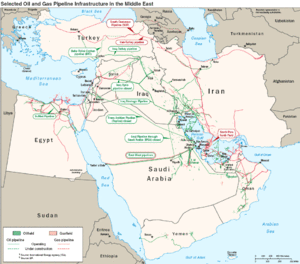
Oil and gas pipelines in the Heart-East
Middle Eastern economies range from existence very poor (such as Gaza and Yemen) to extremely wealthy nations (such equally Qatar and UAE). Overall, as of 2007[update], according to the CIA Earth Factbook, all nations in the Heart Eastward are maintaining a positive rate of growth.
According to the Earth Depository financial institution'southward World Development Indicators database published on July ane, 2009, the three largest Eye Eastern economies in 2008 were Turkey ($794,228), Saudi Arabia ($467,601) and Iran ($385,143) in terms of Nominal Gdp.[55] Regarding nominal Gdp per capita, the highest ranking countries are Qatar ($93,204), the UAE ($55,028), Kuwait ($45,920) and Cyprus ($32,745).[56] Turkey ($i,028,897), Iran ($839,438) and Saudi Arabia ($589,531) had the largest economies in terms of GDP-PPP.[57] When it comes to per capita (PPP)-based income, the highest-ranking countries are Qatar ($86,008), Kuwait ($39,915), the UAE ($38,894), Bahrain ($34,662) and Cyprus ($29,853). The lowest-ranking country in the Middle E, in terms of per capita income (PPP), is the democratic Palestinian Potency of Gaza and the West Bank ($1,100).
The economical structure of Center Eastern nations are different in the sense that while some nations are heavily dependent on export of only oil and oil-related products (such as Saudi arabia, the UAE and Kuwait), others have a highly diverse economic base (such equally Cyprus, Israel, Turkey and Egypt). Industries of the Middle Eastern region include oil and oil-related products, agronomics, cotton, cattle, dairy, textiles, leather products, surgical instruments, defense force equipment (guns, ammunition, tanks, submarines, fighter jets, UAVs, and missiles). Banking is also an important sector of the economies, peculiarly in the case of UAE and Bahrain.
With the exception of Cyprus, Turkey, Egypt, Lebanon and Israel, tourism has been a relatively undeveloped area of the economy, in part because of the socially conservative nature of the region equally well as political turmoil in certain regions of the Middle East. In contempo years, still, countries such equally the UAE, Bahrain, and Jordan have begun attracting greater numbers of tourists because of improving tourist facilities and the relaxing of tourism-related restrictive policies.
Unemployment is notably loftier in the Middle Due east and North Africa region, specially amid immature people aged 15–29, a demographic representing 30% of the region's total population. The total regional unemployment charge per unit in 2005, according to the International Labour Arrangement, was 13.2%,[58] and among youth is as high as 25%,[59] upwards to 37% in Morocco and 73% in Syrian arab republic.[lx]
Climate change

Middle Eastward map of Köppen climate nomenclature

Climate change in the Center Due east and N Africa (MENA) refers to changes in the climate of the MENA region and the subsequent response, adaption and mitigation strategies of countries in the region.[61] In 2018, the MENA region emitted 3.2 billion tonnes of carbon dioxide and produced 8.7% of global greenhouse gas emissions (GHG)[62] despite making up just 6% of the global population.[63] These emissions are mostly from the energy sector,[64] an integral component of many Middle Eastern and Northward African economies due to the extensive oil and natural gas reserves that are establish within the region.[65] [66] The region of Middle East is one of the nearly vulnerable to climate change. The impacts include increment in drought weather, dehydration, heatwaves, sea level rise. If greenhouse gas emissions are not reduced, the region can become uninhabitable before the year 2100.[67] [68]
Sharp global temperature and sea level changes, shifting atmospheric precipitation patterns and increased frequency of extreme weather events are some of the main impacts of climate change as identified by the Intergovernmental Panel on Climate Change (IPCC).[69] The MENA region is especially vulnerable to such impacts due to its arid and semi-arid environment, facing climatic challenges such equally low rainfall, loftier temperatures and dry soil.[69] [seventy] The climatic conditions that foster such challenges for MENA are projected by the IPCC to worsen throughout the 21st century.[69] If greenhouse gas emissions are not significantly reduced, part of the MENA region risks becoming uninhabitable earlier the year 2100.[71] [72] [73]
Climate change is expected to put pregnant strain on already scarce water and agronomical resource within the MENA region, threatening the national security and political stability of all included countries.[74] This has prompted some MENA countries to engage with the issue of climatic change on an international level through environmental accords such as the Paris Agreement. Law and policy are besides existence established on a national level amongst MENA countries,[75] with a focus on the evolution of renewable energies.[76]
Gallery
-

-

-

-

-
-
-

-

Dubai – United Arab Emirates
-

-
-

-

-

-

-

-

-
-

-
This video over the Sahara Desert and the Middle Due east was taken by the crew of Expedition 29 on board the International Space Station.
Come across besides
- Etiquette in the Center East
- Russia and the Centre East
- MENASA
- Mental health in the Center Eastward
- Center Eastern cuisine
- Heart Eastern music
- Cinema of Egypt
- Middle E Studies Association of North America
- Orientalism
- State feminism § Centre East
- Timeline of Center Eastern history
Notes
- ^ In Italian, the expression "Vicino Oriente" (Most Due east) was also widely used to refer to Turkey, and Estremo Oriente (Far East or Extreme East) to refer to all of Asia east of Centre East
- ^ According to the 1993 Statistical Abstruse of Israel there were 250,000 Romanian speakers in Israel, at a population of 5,548,523 (census 1995).
References
- ^ Population 1971–2010 (pdf Archived 2012-01-06 at the Wayback Automobile p. 89) IEA (OECD/ World Bank) (original population ref OECD/ Earth Bank e.g. in IEA Primal World Energy Statistics 2010 p. 57)
- ^ Beaumont, Peter; Blake, Gerald H; Wagstaff, J. Malcolm. The Eye Eastward: A Geographical Study. Second Edition. London: David Fulton. 1988.
- ^ a b Khraish, Louay. "Don't Call Me Middle Eastern". Raseef 22.
- ^ a b Hanafi, Hassan. "The Center Due east, in whose world? (Primary Reflections)". Nordic Society for Middle Eastern Studies (The quaternary Nordic conference on Centre Eastern Studies: The Middle E in globalizing world Oslo, 13–sixteen August 1998). Archived from the original on viii October 2006.
- ^ Cairo, Michael F. The Gulf: The Bush Presidencies and the Middle East Archived 2015-12-22 at the Wayback Machine Academy Press of Kentucky, 2012 ISBN 978-0-8131-3672-one p xi.
- ^ Government Press Office. History of the Office of the Secretary of Defense: The determinative years, 1947–1950 Archived 2015-12-22 at the Wayback Machine ISBN 978-0-16-087640-0 p 177
- ^ Kahana, Ephraim. Suwaed, Muhammad. Historical Dictionary of Middle Eastern Intelligence Archived 2015-12-23 at the Wayback Machine Scarecrow Press, thirteen apr. 2009 ISBN 978-0-8108-6302-6 p. xxxi.
- ^ MacQueen, Benjamin (2013). An Introduction to Middle East Politics: Continuity, Change, Conflict and Co-functioning. SAGE. p. v. ISBN9781446289761.
The Middle Eastward is the cradle of the 3 monotheistic faiths of Judaism, Christianity and Islam.
- ^ Shoup, John A. (2011-ten-31). Ethnic Groups of Africa and the Middle Due east: An Encyclopedia. ISBN978-1-59884-362-0. Archived from the original on 24 April 2016. Retrieved 26 May 2014.
- ^ Beaumont, Blake & Wagstaff 1988, p. 16.
- ^ Koppes, CR (1976). "Captain Mahan, General Gordon and the origin of the term "Middle East"". Middle E Studies. 12: 95–98. doi:10.1080/00263207608700307.
- ^ Lewis, Bernard (1965). The Middle Due east and the West. p. 9.
- ^ Fromkin, David (1989). A Peace to end all Peace. p. 224. ISBN978-0-8050-0857-9.
- ^ Melman, Billie (November 2002), Companion to Travel Writing, Collections Online, vol. half dozen The Middle E/Arabia, Cambridge, archived from the original on July 25, 2011, retrieved Jan 8, 2006 .
- ^ Palmer, Michael A. Guardians of the Farsi Gulf: A History of America's Expanding Office in the Persian Gulf, 1833–1992. New York: The Free Press, 1992. ISBN 0-02-923843-9 pp. 12–xiii.
- ^ Laciner, Dr. Sedat. "Is There a Place Called 'the Heart Eastward'? Archived 2007-02-xx at the Wayback Machine", The Journal of Turkish Weekly, June 2, 2006. Retrieved January 10, 2007.
- ^ Adelson 1995, pp. 22–23.
- ^ Adelson 1995, p. 24.
- ^ Adelson 1995, p. 26.
- ^ a b Davison, Roderic H. (1960). "Where is the Middle East?". Foreign Affairs. 38 (4): 665–75. doi:10.2307/20029452. JSTOR 20029452. S2CID 157454140.
- ^ Held, Colbert C. (2000). Middle Due east Patterns: Places, Peoples, and Politics . Westview Printing. p. 7. ISBN978-0-8133-8221-0.
- ^ Culcasi, Karen (2010). "Constructing and naturalizing the Middle Easr". Geographical Review. 100 (iv): 583–597. doi:10.1111/j.1931-0846.2010.00059.ten. JSTOR 25741178. S2CID 154611116.
- ^ "How the Heart East was invented - The Washington Post". The Washington Mail service.
- ^ "Where Is the Eye E? | Centre for Middle East and Islamic Studies".
- ^ Clyde, Paul Hibbert, and Burton F. Beers. The Far East: A History of Western Impacts and Eastern Responses, 1830-1975 (1975). online
- ^ Norman, Henry. The Peoples and Politics of the Far Due east: Travels and studies in the British, French, Spanish and Portuguese colonies, Siberia, Communist china, Japan, Korea, Siam and Malaya (1904) online
- ^ "'Near East' is Mideast, Washington Explains". The New York Times. August 14, 1958. Archived from the original on October xv, 2009. Retrieved 2009-01-25 . (subscription required)
- ^ Shohat, Ella. "Redrawing American Cartographies of Asia". City University of New York. Archived from the original on 2007-03-12. Retrieved 2007-01-12 .
- ^ Goldstein, Norm. The Associated Printing Stylebook and Conference on Media Law. New York: Basic Books, 2004. ISBN 0-465-00488-one p. 156
- ^ Anderson, Ewan W.; William Bayne Fisher (2000). The Middle East: Geography and Geopolitics. Routledge. pp. 12–thirteen.
- ^ "Earth Economic Outlook Database". International Monetary Fund. 10 Apr 2019. Retrieved May 14, 2019.
- ^ "Report for Selected Countries and Subjects". International Monetary Fund. April 2019. Retrieved May fourteen, 2019.
- ^ Novikova, Gayane (December 2000). "Armenia and the Center East" (PDF). Eye Due east Review of International Affairs. Archived (PDF) from the original on 21 August 2014. Retrieved 14 August 2014.
- ^ Haeri, Safa (2004-03-03). "Concocting a 'Greater Middle East' brew". Asia Times. Archived from the original on 2004-04-07. Retrieved 2008-08-21 .
- ^ Ottaway, Marina & Carothers, Thomas (2004-03-29), The Greater Middle East Initiative: Off to a False Start Archived 2009-03-12 at the Wayback Automobile, Policy Brief, Carnegie Endowment for International Peace, 29, pp. 1–7
- ^ Middle East Archived 2016-04-fifteen at the Wayback Machine What Is The Middle Eastward And What Countries Are Part of It? worldatlas.com. Retrieved 16 April 2016.
- ^ Russell 1985, p. 298. sfn error: no target: CITEREFRussell1985 (assistance)
- ^ Goldschmidt (1999), p. 8
- ^ Louise, Fawcett. International Relations of the Center East. (Oxford University Press, New York, 2005)
- ^ Hassan, Islam; Dyer, Paul (2017). "The State of Middle Eastern Youth". The Muslim World. 107 (1): iii–12. doi:10.1111/muwo.12175. hdl:10822/1042998. Archived from the original on 2017-04-03.
- ^ "IOM Intra regional labour mobility in Arab region Facts and Figures (English)" (PDF). Archived (PDF) from the original on 2011-04-thirty. Retrieved 2012-10-31 .
- ^ Baumer, Christoph (2016). The Church of the East: An Illustrated History of Assyrian Christianity. Bloomsbury Publishing. p. 276. ISBN9781838609344.
Although the Christians of Iran, unlike their Iraqi brothers, were not chosen upwards for military service in the Islamic republic of iran–Iraq War ... was so radical that a genuine exodus took identify – more than than half the 250,000 Christians left Iran later on 1979.
- ^ Cecolin, Alessandra (2015). Iranian Jews in Israel: Betwixt Persian Cultural Identity and Israeli Nationalism. Bloomsbury Publishing. p. 138. ISBN9780857727886.
- ^ Jenkins, Philip (2020). The Rowman & Littlefield Handbook of Christianity in the Middle Eastward. Rowman & Littlefield. p. XLVIII. ISBN9781538124185.
The Middle East however stands at the eye of the Christian world. After all, information technology is the birthplace, and the death identify, of Christ, and the cradle of the Christian tradition.
- ^ Curtis, Michael (2017). Jews, Antisemitism, and the Middle Eastward. Routledge. p. 173. ISBN9781351510721.
Christian communities and individuals take played a vital office in the Center East, the cradle of Christianity as of other religions.
- ^ Nelida Fuccaro (1999). The Other Kurds: Yazidis in Colonial Iraq. London & New York: I.B. Tauris. p. 9. ISBN1860641709.
- ^ C. Held, Colbert (2008). Center East Patterns: Places, People, and Politics. Routledge. p. 109. ISBN9780429962004.
Worldwide, they number 1 one thousand thousand or so, with almost 45 to l percent in Syria, 35 to 40 percent in Lebanon, and less than x pct in State of israel. Recently there has been a growing Druze diaspora.
- ^ "Europe :: Akrotiri — The World Factbook - Key Intelligence Agency". CIA. 25 October 2021.
- ^ "Europe :: Dhekelia — The World Factbook - Central Intelligence Agency". CIA. 25 Oct 2021.
- ^ "World Factbook – Jordan". 20 October 2021.
- ^ "Kuwait". Central Intelligence Agency. Oct nineteen, 2021 – via CIA.gov.
- ^ Dowty 2004, p. 95. sfn error: no target: CITEREFDowty2004 (aid)
- ^ "Reports of about 300,000 Jews that left the country afterwards WW2". Eurojewcong.org. Archived from the original on 2010-08-13. Retrieved 2010-07-07 .
- ^ "Evenimentul Zilei". Evz.ro. Archived from the original on 2007-12-24. Retrieved 2010-07-07 .
- ^ The World Bank: Globe Economic Indicators Database. Gdp (Nominal) 2008. Archived 2009-09-12 at the Wayback Auto Data for 2008. Terminal revised on July 1, 2009.
- ^ Data refer to 2008. World Economical Outlook Database-Oct 2009, International Budgetary Fund. Retrieved October i, 2009.
- ^ The World Banking concern: World Economic Indicators Database. Gdp (PPP) 2008. Archived 2014-02-09 at the Wayback Machine Information for 2008. Last revised on July ane, 2009.
- ^ "Unemployment Rates Are Highest in the Middle East". Progressive Policy Institute. August xxx, 2006. Archived from the original on July xiv, 2010. Retrieved July 31, 2008.
- ^ Navtej Dhillon; Tarek Yousef (2007). "Inclusion: Meeting the 100 Million Youth Claiming". Shabab Inclusion. Archived from the original on 2008-11-09.
- ^ Hilary Silverish (December 12, 2007). "Social Exclusion: Comparative Analysis of Europe and Middle E Youth". Middle Due east Youth Initiative Working Paper. Shabab Inclusion. Archived from the original on August 20, 2008. Retrieved July 31, 2008.
- ^ Olawuyi, Damilola (31 July 2021). Climate change Police and Policy in the Middle East and Northward Africa Region (1st ed.). London: Routledge. pp. one–340. ISBN9780367490324 . Retrieved 26 September 2021.
- ^ "CO2 Emissions | Global Carbon Atlas". www.globalcarbonatlas.org . Retrieved 2020-04-10 .
- ^ "Population, full - Eye East & N Africa, World | Information". information.worldbank.org . Retrieved 2020-04-11 .
- ^ Abbass, Rana Alaa; Kumar, Prashant; El-Gendy, Ahmed (February 2018). "An overview of monitoring and reduction strategies for health and climate change related emissions in the Middle East and North Africa region" (PDF). Atmospheric Environment. 175: 33–43. Bibcode:2018AtmEn.175...33A. doi:ten.1016/j.atmosenv.2017.11.061. ISSN 1352-2310.
- ^ Al-mulali, Usama (2011-10-01). "Oil consumption, CO2 emission and economic growth in MENA countries". Energy. 36 (10): 6165–6171. doi:x.1016/j.free energy.2011.07.048. ISSN 0360-5442.
- ^ Tagliapietra, Simone (2019-11-01). "The touch of the global energy transition on MENA oil and gas producers". Energy Strategy Reviews. 26: 100397. doi:x.1016/j.esr.2019.100397. ISSN 2211-467X.
- ^ "How the Middle Eastward is suffering on the front lines of climate change". World Economic Forum . Retrieved 2022-01-xviii .
- ^ Gornall, Jonathan (2018-12-21). "With climate change, life in the Gulf could become impossible". www.euractiv.com . Retrieved 2022-01-18 .
- ^ a b c IPCC, 2014: Climate Change 2014: Synthesis Study. Contribution of Working Groups I, II and 3 to the Fifth Assessment Study of the Intergovernmental Panel on Climate Modify [Core Writing Squad, R.Thousand. Pachauri and 50.A. Meyer (eds.)]. IPCC, Geneva, Switzerland, 151 pp.
- ^ El-Fadel, M.; Bou-Zeid, E. (2003). "Climate alter and water resources in the Middle East: vulnerability, socio-economic impacts and adaptation". Climate Change in the Mediterranean. doi:10.4337/9781781950258.00015. hdl:10535/6396. ISBN9781781950258.
- ^ Broom, Douglas. "How the Heart East is suffering on the front lines of climate change". World Economic Forum . Retrieved iv Feb 2020.
- ^ Gornall, Jonathan (24 April 2019). "With climate modify, life in the Gulf could get impossible". Euroactive. Retrieved 4 Feb 2020.
- ^ Pal, Jeremy S.; Eltahir, Elfatih A. B. (2015-10-26). "Future temperature in western asia projected to exceed a threshold for human being adaptability". Nature Climate Alter. half dozen (2): 197–200. doi:10.1038/nclimate2833. ISSN 1758-678X.
- ^ Waha, Katharina; Krummenauer, Linda; Adams, Sophie; Aich, Valentin; Baarsch, Florent; Coumou, Dim; Fader, Marianela; Hoff, Holger; Jobbins, Guy; Marcus, Rachel; Mengel, Matthias (2017-04-12). "Climate change impacts in the Middle East and Northern Africa (MENA) region and their implications for vulnerable population groups". Regional Environmental Alter. 17 (six): 1623–1638. doi:10.1007/s10113-017-1144-2. ISSN 1436-3798. S2CID 134523218.
- ^ Olawuyi, Damilola (31 July 2021). Climate change Law and Policy in the Middle Due east and Due north Africa Region (1st ed.). United Kingdom: Routledge. pp. 3–21. ISBN9780367490324 . Retrieved 2 September 2021.
- ^ Brauch, Hans Günter (2012), "Policy Responses to Climatic change in the Mediterranean and MENA Region during the Anthropocene", Climatic change, Man Security and Violent Conflict, Hexagon Series on Human being and Environmental Security and Peace, vol. 8, Springer Berlin Heidelberg, pp. 719–794, doi:10.1007/978-iii-642-28626-1_37, ISBN978-iii-642-28625-4
Further reading
- Adelson, Roger (1995). London and the Invention of the Middle East: Money, Power, and War, 1902–1922. Yale University Press. ISBN978-0-300-06094-two.
- Anderson, R; Seibert, R; Wagner, J. (2006). Politics and Modify in the Center Due east (8th ed.). Prentice-Hall.
- Barzilai, Gad; Aharon, Klieman; Gil, Shidlo (1993). The Gulf Crisis and its Global Aftermath . Routledge. ISBN978-0-415-08002-vi.
- Barzilai, Gad (1996). Wars, Internal Conflicts and Political Gild. State University of New York Press. ISBN978-0-7914-2943-3.
- Beaumont, Peter; Blake, Gerald H; Wagstaff, J. Malcolm (1988). The Centre Eastward: A Geographical Study. David Fulton. ISBN978-0-470-21040-6.
- Bishku, Michael B. (2015). "Is the Due south Caucasus Region a Part of the Middle Due east?". Journal of Tertiary World Studies. 32 (1): 83–102. JSTOR 45178576.
- Cleveland, William L., and Martin Bunton. A History Of The Modern Middle East (sixth ed. 2018 fourth ed. online
- Cressey, George B. (1960). Crossroads: State and Life in Western asia. Chicago, IL: J.B. Lippincott Co. xiv, 593 pp. ill. with maps and b&w photos.
- Fischbach, ed. Michael R. Biographical encyclopedia of the modernistic Middle E and North Africa (Gale Grouping, 2008).
- Freedman, Robert O. (1991). The Middle East from the Iran-Contra Affair to the Intifada, in series, Contemporary Problems in the Centre E. 1st ed. Syracuse, NY: Syracuse University Press. x, 441 pp. ISBN 0-8156-2502-ii pbk.
- Goldschmidt, Arthur Jr (1999). A Curtailed History of the Heart East. Westview Printing. ISBN978-0-8133-0471-7.
- Halpern, Manfred. Politics of Social Change: In the Heart E and Northward Africa (Princeton University Press, 2015).
- Ismael, Jacqueline S., Tareq Y. Ismael, and Glenn Perry. Government and politics of the contemporary Middle East: Continuity and modify (Routledge, 2015).
- Lynch, Marc, ed. The Arab Uprisings Explained: New Contentious Politics in the Middle East (Columbia University Printing, 2014). p. 352.
- Palmer, Michael A. (1992). Guardians of the Western farsi Gulf: A History of America'southward Expanding Office in the Persian Gulf, 1833–1992. New York: The Free Press. ISBN978-0-02-923843-1.
- Reich, Bernard. Political leaders of the contemporary Middle E and North Africa: a biographical lexicon (Greenwood Publishing Group, 1990).
- Vasiliev, Alexey. Russia'south Middle East Policy: From Lenin to Putin (Routledge, 2018).
External links

- "Middle East – Articles by Region" Archived 2014-02-09 at the Wayback Auto – Council on Foreign Relations: "A Resource for Nonpartisan Research and Analysis"
- "Eye Eastward – Interactive Crisis Guide" Archived 2009-11-thirty at the Wayback Automobile – Council on Foreign Relations: "A Resource for Nonpartisan Research and Analysis"
- Centre East Department Academy of Chicago Library
- Middle East Business Intelligence since 1957: "The leading data source on business organization in the Eye E" – MEED.com
- Carboun – advocacy for sustainability and environmental conservation in the Eye East
- Middle East at Curlie
- Middle East News from Yahoo! News
- Middle East Business concern, Financial & Manufacture News – ArabianBusiness.com
Source: https://en.wikipedia.org/wiki/Middle_East
0 Response to "what continent does the middle east belong to"
Postar um comentário